China's 240-hour visa-free transit: routes, entry points and steps
Checked
Short answer
If your passport is from one of 57 countries and you have a ticket out of China to a different country, you can stay up to 240 hours (10 days) in parts of mainland China without a visa.1
Check your route: you must fly in from one country and leave for a different one.
Where you can go: arrive at one of 65 entry points and stay in the areas listed below.
Count your 240 hours from 00:00 on the day after you arrive.
At check-in, bring your ticket out of China and a printout of the rules.
At the border, ask for 240-hour visa-free transit. Fill in your arrival card beforehand.
Check your route
You need a regular passport from one of the 57 countries on the list, which includes the United States, the United Kingdom and Russia.1 The full list is at the end of this page, and our visa check shows every way into China that your passport allows.
The country you fly into China from and the country you leave for must be different — a round trip doesn’t count.1 For example, flying in from Japan and out to South Korea works. Flying in from Japan and back to Japan does not. Travelers who flew in from Hong Kong and tried to leave through Hong Kong were stopped at check-in. Hong Kong, Macao and Taiwan each count as a separate country for this rule, so you can come in from Hong Kong and leave for Macao.
Book a ticket out of China to a different country, with a confirmed seat and a date within the 240 hours.1, 2 Count your 240 hours below shows how to work out your last day.
Your passport must be valid for at least 3 months, and you must meet the entry rules of your next country.2
Not sure your route counts? Call the National Immigration Administration’s 12367 hotline, or +86 12367 from outside China.3 It answers questions on the policy 24 hours a day, in several languages.4
Where you can go
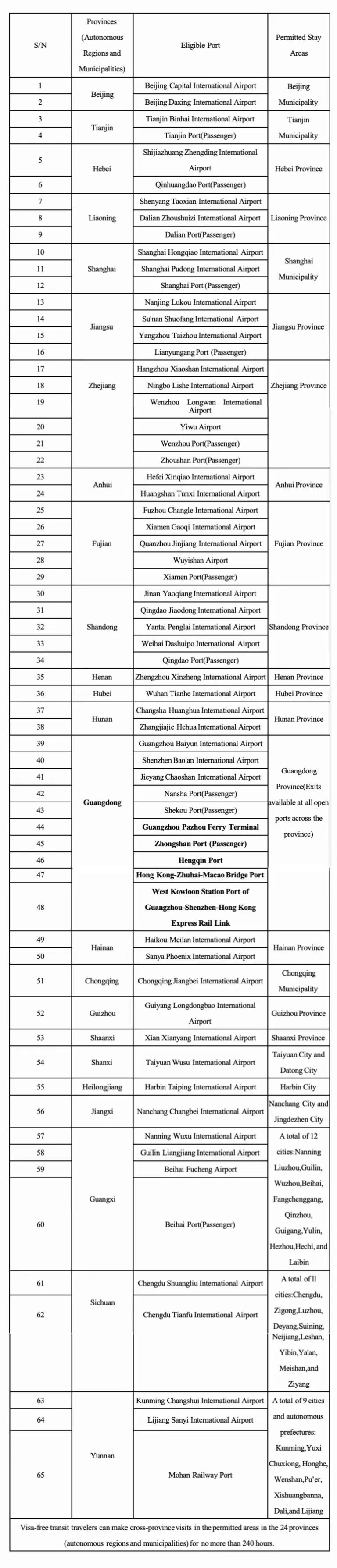
Arrive at one of 65 entry points across 24 provinces, and stay in the areas listed for each province below. You can travel between provinces — for example, fly in to Shanghai and take the train to Beijing — as long as you stay in the listed areas.1
The list below shows each province’s entry points and where you can go: the whole province, or only the places named.1
Beijing
- Beijing Capital International Airport
- Beijing Daxing International Airport
Where you can stayBeijing Municipality
Tianjin
- Tianjin Binhai International Airport
- Tianjin Port (Passenger)
Where you can stayTianjin Municipality
Hebei
- Shijiazhuang Zhengding International Airport
- Qinhuangdao Port (Passenger)
Where you can stayHebei Province
Liaoning
- Shenyang Taoxian International Airport
- Dalian Zhoushuizi International Airport
- Dalian Port (Passenger)
Where you can stayLiaoning Province
Shanghai
- Shanghai Hongqiao International Airport
- Shanghai Pudong International Airport
- Shanghai Port (Passenger)
Where you can stayShanghai Municipality
Jiangsu
- Nanjing Lukou International Airport
- Su'nan Shuofang International Airport
- Yangzhou Taizhou International Airport
- Lianyungang Port (Passenger)
Where you can stayJiangsu Province
Zhejiang
- Hangzhou Xiaoshan International Airport
- Ningbo Lishe International Airport
- Wenzhou Longwan International Airport
- Yiwu Airport
- Wenzhou Port (Passenger)
- Zhoushan Port (Passenger)
Where you can stayZhejiang Province
Anhui
- Hefei Xinqiao International Airport
- Huangshan Tunxi International Airport
Where you can stayAnhui Province
Fujian
- Fuzhou Changle International Airport
- Xiamen Gaoqi International Airport
- Quanzhou Jinjiang International Airport
- Wuyishan Airport
- Xiamen Port (Passenger)
Where you can stayFujian Province
Shandong
- Jinan Yaoqiang International Airport
- Qingdao Jiaodong International Airport
- Yantai Penglai International Airport
- Weihai Dashuipo International Airport
- Qingdao Port (Passenger)
Where you can stayShandong Province
Henan
- Zhengzhou Xinzheng International Airport
Where you can stayHenan Province
Hubei
- Wuhan Tianhe International Airport
Where you can stayHubei Province
Hunan
- Changsha Huanghua International Airport
- Zhangjiajie Hehua International Airport
Where you can stayHunan Province
Guangdong
- Guangzhou Baiyun International Airport
- Shenzhen Bao'an International Airport
- Jieyang Chaoshan International Airport
- Nansha Port (Passenger)
- Shekou Port (Passenger)
- Guangzhou Pazhou Ferry Terminal
- Zhongshan Port (Passenger)
- Hengqin Port
- Hong Kong-Zhuhai-Macao Bridge Port
- West Kowloon Station Port of Guangzhou-Shenzhen-Hong Kong Express Rail Link
Where you can stayGuangdong Province (Exits available at all open ports across the province)
Hainan
- Haikou Meilan International Airport
- Sanya Phoenix International Airport
Where you can stayHainan Province
Chongqing
- Chongqing Jiangbei International Airport
Where you can stayChongqing Municipality
Guizhou
- Guiyang Longdongbao International Airport
Where you can stayGuizhou Province
Shaanxi
- Xi'an Xianyang International Airport
Where you can stayShaanxi Province
Shanxi
- Taiyuan Wusu International Airport
Where you can stayTaiyuan City and Datong City
Heilongjiang
- Harbin Taiping International Airport
Where you can stayHarbin City
Jiangxi
- Nanchang Changbei International Airport
Where you can stayNanchang City and Jingdezhen City
Guangxi
- Nanning Wuxu International Airport
- Guilin Liangjiang International Airport
- Beihai Fucheng Airport
- Beihai Port (Passenger)
Where you can stayA total of 12 cities: Nanning, Liuzhou, Guilin, Wuzhou, Beihai, Fangchenggang, Qinzhou, Guigang, Yulin, Hezhou, Hechi, and Laibin
Sichuan
- Chengdu Shuangliu International Airport
- Chengdu Tianfu International Airport
Where you can stayA total of 11 cities: Chengdu, Zigong, Luzhou, Deyang, Suining, Neijiang, Leshan, Yibin, Ya'an, Meishan, and Ziyang
Yunnan
- Kunming Changshui International Airport
- Lijiang Sanyi International Airport
- Mohan Railway Port
Where you can stayA total of 9 cities and autonomous prefectures: Kunming, Yuxi, Chuxiong, Honghe, Wenshan, Pu'er, Xishuangbanna, Dali, and Lijiang
If you enter at one of the 10 entry points in Guangdong, you can leave from any of them.1 For other provinces, the rules do not say where you must leave from1, 2, 4, 5, but travelers report leaving from a different city — for example, flying in to Shanghai and out of Beijing.
Count your 240 hours
The 240 hours start at 00:00 on the day after you arrive.2 So if you arrive on May 1, at any time of day, they run from 00:00 on May 2 to 24:00 on May 11, and you must have left by then.1, 2
If you need to stay longer or go outside the listed areas, apply at the nearest police station before your time is up.4
At check-in
Airline staff may not know the 240-hour rules and may ask for your visa. Print your ticket out of China and the National Immigration Administration’s page on the policy. Allow an extra 20 to 50 minutes at the counter.
At the border
You need to fill in an arrival card. Fill it in before you travel: on the National Immigration Administration’s website, in its NIA 12367 app, or in its WeChat or Alipay mini program. If you don’t fill it in beforehand, you can do it at the border: scan a QR code with your phone, use a machine, or fill in a paper card. The arrival card website:2 s.nia.gov.cn/ArrivalCardFillingPC.
At immigration, tell the officers you are using 240-hour visa-free transit.2 Look for the visa-free transit lane.4
Officers check your ticket out of China and may ask for your hotel bookings — print them. The arrival card asks where you are staying, so keep your hotel’s name and address ready.
Where you stay
At a hotel, the hotel handles your registration with the police.6 If you stay anywhere else — with friends, in a rental — you or your host must register with the local police within 24 hours.6, 7
You or your host can register online: on the National Immigration Administration’s website, in its NIA 12367 app or WeChat mini program, or in the Alipay mini program. Your host should help the first time. If the online form doesn’t work, register in person at the nearest police station.6
Only changing planes?
Changing planes within 24 hours and staying in the transit area? You need no visa, whatever your passport, as long as your ticket has a confirmed seat.1 You can skip the arrival card too.2
To leave the transit area, even for a few hours, ask the border officers at the airport for a temporary entry permit.1 If your passport is on the 240-hour list and the airport is one of the 65 entry points, you can use the 240 hours instead — fill in an arrival card as described above.1, 2
Countries on the list
The 57 countries whose regular passports qualify:1
- Albania
- Argentina
- Australia
- Austria
- Belarus
- Belgium
- Bosnia and Herzegovina
- Brazil
- Brunei
- Bulgaria
- Canada
- Chile
- Croatia
- Cyprus
- Czech Republic
- Denmark
- Estonia
- Finland
- France
- Germany
- Greece
- Hungary
- Iceland
- Indonesia
- Ireland
- Italy
- Japan
- Kyrgyzstan
- Latvia
- Lithuania
- Luxembourg
- Malta
- Mexico
- Monaco
- Montenegro
- Netherlands
- New Zealand
- North Macedonia
- Norway
- Poland
- Portugal
- Qatar
- Romania
- Russia
- Serbia
- Singapore
- Slovakia
- Slovenia
- South Korea
- Spain
- Sweden
- Switzerland
- Ukraine
- United Arab Emirates
- United Kingdom
- United States
- Vietnam
Updated
Sources
Every rule on this page links to the official page it comes from: 7 pages in all, checked between November 13, 2026 and November 15, 2026.
Show all sourcesHide sources
- 1National Immigration AdministrationVisa-Free Transit Policies
Currently, China is implementing this policy for nationals of 57 countries including Russia, the United Kingdom and the United States. Nationals of these countries, who need to transit through China to third countries or regions, may enter visa-free through any of the designated 65 open exit-entry ports in 24 provinces, autonomous regions and municipalities directly under the Central Government and stay in the permitted areas for no more than 10 days, provided that they hold ordinary passports and onward tickets with confirmed seats and departure dates.
Europe (40 countries): Albania, Austria, Belarus, Belgium, Bosnia and Herzegovina, Bulgaria, Croatia, Cyprus, Czech Republic, Denmark, Estonia, Finland, France, Germany, Greece, Hungary, Iceland, Ireland, Italy, Latvia, Lithuania, Luxembourg, Malta, Monaco, Montenegro, the Netherlands, North Macedonia, Norway, Poland, Portugal, Romania, Russia, Serbia, Slovakia, Slovenia, Spain, Sweden, Switzerland, Ukraine, United Kingdom
North America (2 countries): Canada, United States
South America (4 countries): Argentina, Brazil, Chile, Mexico
Oceania (2 countries): Australia, New Zealand
Asia (9 countries): Brunei, Indonesia, Japan, Kyrgyzstan, Qatar, Singapore, South Korea, United Arab Emirates, Vietnam
From an image on this page. Open the image
All open exit-entry ports in China implement this policy for nationals of all other countries around the world.
Foreigners transiting through China to third countries or regions may stay in China for no more than 24 hours without a visa, provided that they hold valid international travel documents and onward international flight/ship/train tickets with confirmed seats, and will not leave the restricted areas of ports.
For any foreigner who does need to leave the designated restricted area, a temporary entry permit must be obtained first at the immigration inspection authority of the port concerned.
- 2National Immigration AdministrationAnnouncement on Implementing 10 New Measures to Support the Expansion of Opening-up and Serve High-quality Development
III. The applicant must hold interline tickets to a third country(region) with confirmed arrangements and departure dates within 240 hours or other proof documents, fill in the Arrival Card for Temporary Entry Foreigners and cooperate with inspections by the immigration authorities.
II. The applicant must hold a valid international travel document (with a validity of at least 3 months) and meet the requirements for entering a third country(region).
The immigration inspection authorities will handle the temporary entry formalities, and the visa-free stay period will be calculated from 0:00 on the day following the day of entry.
Effective November 20th, 2025, foreigners may fill in the relevant entry information online before coming to China through NIA’s official website, Government Service Platform, “NIA 12367” APP and WeChat (Alipay) mini program or by scanning the QR code with mobile phones. Foreigners who cannot fill in the information online in advance may complete the process upon arriving at the immigration inspection site in the ports of China by scanning the QR code with mobile phones or using the smart devices at the port to fill in the entry information online or filling in the paper Arrival Card.
https://s.nia.gov.cn/ArrivalCardFillingPC/
Foreign nationals who meet the above conditions may apply to the immigration inspection authorities at the 65 ports in Beijing, Shanghai and Guangdong, etc., for the 240-hour visa exemption.
The following 7 types of foreigners may be exempted from filling in the Arrival Card:
d. transiting directly within 24 hours without leaving the restricted area of the port;
- 3National Immigration Administration · In ChineseChina's 240-hour visa-free transit policy中国240小时过境免签政策Our translation
For the specific itinerary you asked about, please call the National Immigration Administration's 12367 service hotline for detailed advice; if you are outside China, please dial 8612367.
对于您提出的具体行程问题,请拨打中国国家移民管理局12367服务热线作详细咨询,如您在境外,请拨打8612367。
- 4National Immigration Administration · In ChineseThe National Immigration Administration holds a press conference on relaxing and optimizing the visa-free transit policy国家移民管理局举行放宽优化过境免签政策新闻发布会Our translation
China's immigration authorities will give foreign travelers a leaflet when they arrive at the port, as guidance on the visa-free transit policy; the National Immigration Administration's 12367 platform also runs a 24-hour hotline that answers policy questions in several languages, for callers around the world
中国移民管理部门将在外籍旅客抵达口岸时为其发放提示单,提供过境免签政策指引服务,同时,国家移民局12367 平台24小时服务热线向全球提供多语种政策咨询解答服务
Our translationAnyone who, for an urgent and reasonable cause, force majeure or a similar reason, needs to stay in China beyond the time allowed, or to go beyond the area where the stay is permitted, should apply in advance to the exit-entry administration of the local public security authority for a stay permit.
如有紧急合理事由或不可抗力等原因需在中国境内停留超过规定时限,或者超出准予停留区域的,应提前向所在地公安机关出入境管理部门申请办理停留证件。
Our translationInspection areas at ports are laid out, dedicated areas are set up to handle temporary entry permits, and leaflets on the visa-free transit policy are printed and handed out, so that travelers applying for temporary transit get a convenient and efficient service
科学划定口岸查验区域,安排专区办理临时入境许可,印发过境免签政策提示单,为申请办理临时过境旅客提供便捷高效服务
- 5
- 6National Immigration AdministrationPolicy Interpretation of the Nationwide Implementation of the Online Accommodation Registration Service for Foreigners Residing or Staying in Domiciles Other Than Hotels
where foreigners stay in hotels in China, the hotels shall register their accommodation in accordance with the regulations on the public security administration of the hotel industry, and submit foreigners’ accommodation registration information to the public security organs in the places where the hotels are located. For foreigners who reside or stay in domiciles other than hotels, they or the persons who accommodate them shall, within 24 hours after the foreigners’ arrival, go through the registration formalities with the public security organs in the places of residence.
Foreigners who reside or stay in domiciles other than hotels may go through the registration formalities online without the need to visit the public security organs in person.
Accommodation hosts or foreigners may access the NIA Government Service Platform , including the official website, the “NIA 12367” App, and “NIA 12367” WeChat mini program, or the Alipay mini program.
the initial registration should be completed with their assistance to ensure the accuracy of the registration information.
they may visit the exit-entry administration service windows of the local public security organs or local police stations to seek assistance with on-site registration.
- 7China Consular Services, Ministry of Foreign AffairsExit and Entry Administration Law of the People's Republic of ChinaOur translation
Foreigners who reside or stay in a domicile other than a hotel shall, within 24 hours of moving in, go through registration with the public security authority of their place of residence, themselves or through the person who accommodates them.
外国人在旅馆以外的其他住所居住或者住宿的,应当在入住后二十四小时内由本人或者留宿人,向居住地的公安机关办理登记。
Each small number in the text is one of the 7 official pages under Sources at the end, checked between November 13, 2026 and November 15, 2026.
Where this comes from